

How Is Facial Tissue Packing Machine Cost Calculated?
A Facial Tissue Packing Machine quotation normally consists of more than the packaging machine itself. The final investment may include the main machine, feeding system, sealing unit, conveyors, sensors, coding equipment, electrical controls, changeover parts, safety guards, spare parts, technical documentation, installation, training, shipping, and optional automation modules.
The biggest mistake buyers make is comparing quotations only by the total number at the bottom of the page. Two machines may look similar in photographs but have very different mechanical structures, operating speeds, servo configurations, sensor systems, electrical brands, sealing stability, and compatibility ranges. One supplier may quote a machine configured for a single product size, while another may include several changeover sets for multiple tissue formats.
Machine Price vs. Total Project Cost
When preparing a purchasing budget, separate the equipment price from the total project cost. The machine price covers the physical equipment, while the total project cost may include freight, customs clearance, factory utilities, electrical work, compressed air preparation, installation, operator training, spare parts inventory, packaging film testing, and production downtime during commissioning.
For this reason, buyers should ask suppliers to clearly define the scope of supply. A detailed quotation allows you to compare machines on an equivalent basis instead of assuming that every supplier includes the same items.
Facial Tissue Packing Machine Cost Breakdown
Main Packing Machine
The main packing machine includes the machine frame, product feeding system, wrapping unit, sealing system, cutting mechanism, and control system. The final cost can vary depending on production speed, machine structure, number of servo motors, control configuration, and overall automation level.
Product Feeding System
The product feeding system transfers facial tissue packs into the packing section and positions them correctly before wrapping. Depending on production requirements, the system can be manual, semi-automatic, or fully automatic. Higher automation may require additional conveyors, sensors, motors, and control components, which can increase the overall investment.
Servo and Motion Control
Servo motors, PLCs, drives, HMIs, sensors, and synchronized motion components control the machine's movement and operating accuracy. The number of controlled axes and the brands of electrical components can affect the quotation. Buyers should also consider whether the selected components are easy to maintain and source locally.
Sealing System
The sealing system handles film feeding, heat sealing, cutting, and temperature control. Its configuration depends on the packaging material, required seal quality, film characteristics, and target production speed. A machine designed for stable high-speed packaging may require more precise temperature control and film handling components.
Changeover Parts
Changeover parts include product guides, forming components, fixtures, and other adjustable mechanisms used when switching between different facial tissue sizes. If your factory produces multiple product formats, additional change parts may be required. The number of product sizes and the complexity of the changeover process can therefore affect the total machine cost.
Coding Equipment
Coding equipment can be used for printing production dates, batch numbers, product information, or other required markings. Options may include inkjet printers, thermal transfer systems, labeling equipment, or other coding technologies. The price depends on the selected technology, print requirements, and level of integration with the Facial Tissue Packing Machine.
Inspection Equipment
Inspection equipment may include product detection sensors, automatic rejection systems, barcode verification, vision inspection, or other quality-control functions. These options can help identify packaging defects or incorrect products during production. The cost varies according to the required inspection accuracy, number of inspection points, and integration requirements.
Spare Parts
Spare parts may include belts, heaters, blades, sensors, seals, electrical components, and other consumable or replacement parts. Some suppliers include a basic spare-parts package, while others quote it separately. Buyers should confirm which critical components are included and consider purchasing commonly replaced parts before starting production.
Installation and Training
Installation and training may include machine commissioning, operator training, maintenance instruction, production testing, and basic troubleshooting guidance. The final cost can depend on the installation location, required service duration, engineer travel, and level of technical support. Always confirm whether installation and training are included in the quoted price.
Shipping and Delivery
Shipping costs may include export packing, inland transportation, sea or air freight, and insurance where applicable. The final amount depends on the destination, machine dimensions and weight, shipping method, and agreed trade terms. Buyers should confirm whether the supplier's quotation covers transportation or only the machine itself.
9 Factors That Affect Facial Tissue Packing Machine Quotations
1. Required Production Speed
Production speed is one of the most important pricing factors. A manufacturer that only needs moderate output may not require the same drive system, feeding mechanism, or control architecture as a factory operating several high-capacity converting lines. Higher speed generally requires more precise synchronization, stronger mechanical components, and better motion control.
2. Tissue Pack Dimensions
Before requesting a quotation, prepare the length, width, height, sheet count, folded tissue dimensions, and finished package format. Machines designed for a broad size range may require more adjustable mechanisms or additional forming components.
3. Packaging Material
Different wrapping films behave differently during feeding, sealing, and cutting. Film thickness, heat-sealing properties, print registration requirements, and roll dimensions can affect machine configuration. Buyers should send packaging material samples to the supplier whenever possible.
4. Automation Level
A stand-alone Facial Tissue Packing Machine may require operators to feed products manually. A fully automatic line can receive tissue packs directly from upstream converting equipment and transfer them to downstream cartoning or case packing machines. The more automated the line, the higher the initial investment, but labor requirements may decrease.
5. Electrical and Control Components
PLC, HMI, servo drives, sensors, relays, breakers, and pneumatic components can differ significantly between quotations. Buyers with existing factory standards may request specific component brands to simplify maintenance and spare-parts management.
6. Number of Product Formats
If your factory produces several facial tissue pack sizes, ask how the machine handles changeovers. Some machines rely mainly on adjustable settings, while others require mechanical change parts. More formats can increase tooling cost and changeover complexity.
7. Additional Functions
Optional functions may include automatic film splicing, coding, labeling, film registration, product detection, rejection systems, remote diagnostics, data collection, inspection cameras, conveyors, and downstream automation. Each option should be listed separately in the quotation.
8. Installation and Service Requirements
International projects may require remote commissioning, on-site engineer support, multilingual manuals, operator training, or long-term service agreements. Always confirm whether these services are included in the quoted machine price.
9. Factory Integration
If the new packing machine must connect to existing tissue converting, conveying, cartoning, bundling, or case packing equipment, engineering work may be necessary. Integration should be discussed before ordering rather than after the equipment reaches the factory.
3 Budget Scenarios for Different Facial Tissue Packing Machine Buyers
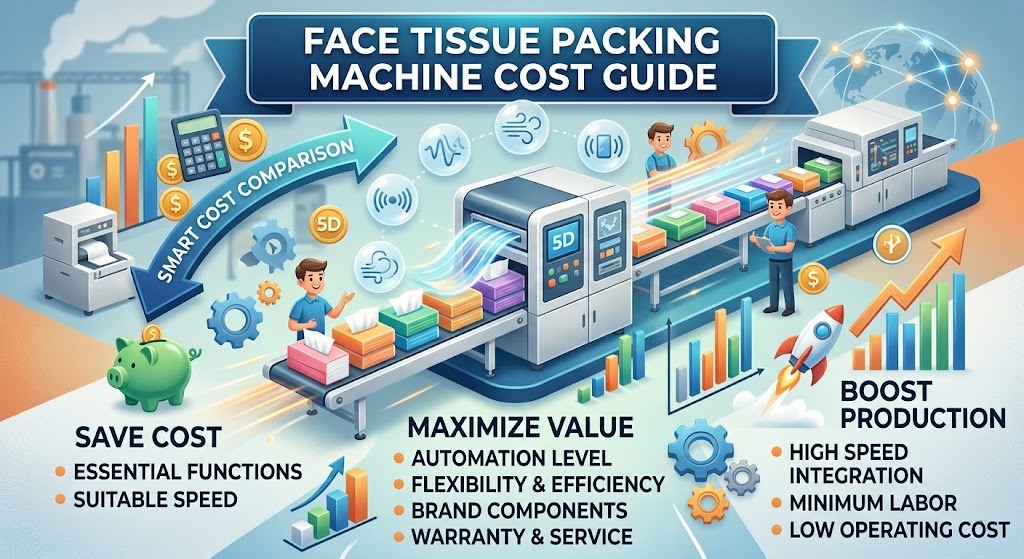
Budget-Focused: Start With Essential Packaging Functions
For a smaller tissue manufacturer, a new production line, or a factory with moderate output, the priority may be dependable basic packing rather than maximum automation. Focus on stable sealing, suitable speed, simple operation, accessible maintenance, and compatibility with your primary tissue size. Avoid paying for functions you do not currently need, but confirm whether the machine can be upgraded later.
Balanced: Prioritize Flexibility and Production Efficiency
For established manufacturers producing multiple tissue SKUs, a balanced configuration is often more practical. Consider automatic feeding, servo control, user-friendly recipes, faster size changeover, stable film registration, and sufficient production speed. The goal is to reduce labor and changeover time without purchasing unnecessary high-end automation.
High-Spec: Build for Continuous and Integrated Production
Large-scale tissue manufacturers may prioritize high-speed continuous production, integration with upstream and downstream equipment, automated inspection, remote diagnostics, standardized electrical components, production data collection, and minimum operator intervention. In this scenario, the initial machine price is only one part of the decision; uptime, maintenance efficiency, spare-parts availability, and total cost of ownership become more important.
8 Questions to Ask Before Accepting a Facial Tissue Packing Machine Quotation
What exactly is included in the quoted price? Ask for a detailed scope covering the main machine, conveyors, coding, spare parts, installation, training, and optional devices.
What production speed is guaranteed for my actual product? Do not rely only on theoretical maximum speed. Ask about output under your tissue dimensions and packaging material.
Which tissue pack sizes can the machine handle? Confirm minimum and maximum dimensions and whether additional tooling is required.
How long does product changeover take? Frequent SKU changes can significantly affect real production efficiency.
Which electrical and pneumatic brands are used? This directly affects maintenance, spare-parts sourcing, and factory standardization.
What are the warranty terms? Clarify warranty duration, exclusions, labor responsibility, shipping of replacement parts, and remote support.
What is the estimated delivery and commissioning schedule? Separate manufacturing lead time, shipping time, installation, and trial production.
What payment terms apply? Confirm deposit percentage, production milestone payments, inspection requirements, and final balance conditions before signing.
Procurement tip: Ask all shortlisted suppliers to quote against the same requirement sheet. Include pack dimensions, film specification, target speed, power supply, automation requirements, preferred control brands, destination, and expected accessories. This makes quotation comparison much more meaningful.
Common Hidden Costs and Purchasing Mistakes
Comparing Only the Machine Price
A machine that costs less initially may require more manual labor, additional equipment, more frequent adjustments, or more expensive maintenance. Compare total project cost instead of the machine price alone.
Ignoring Packaging Material Testing
The machine should be tested with packaging material that is as close as possible to your actual production film. A machine running well with one sample film may behave differently with another thickness, friction level, or sealing property.
Not Confirming Utility Requirements
Check electrical voltage, frequency, compressed air consumption, machine footprint, access space, and environmental requirements before delivery. Factory modifications made at the last minute can create unnecessary costs.
Underestimating Spare Parts
Ask which parts are consumable and which components have long replacement lead times. Keeping critical spare parts in stock can reduce downtime if a component fails during production.
Ignoring After-Sales Response
Technical support is particularly important for overseas equipment. Ask whether the supplier offers remote troubleshooting, video assistance, software support, spare-parts shipment, and on-site service if required.
How to Choose the Right Facial Tissue Packing Machine Supplier
A good supplier should do more than send a quotation. The supplier should understand your production process and ask technical questions before recommending a machine. If a manufacturer immediately quotes a standard model without asking about tissue dimensions, packaging film, target speed, factory power supply, required automation, and downstream equipment, the quotation may not reflect your actual needs.
Ask for machine videos running products similar to yours.
Request a clear technical specification sheet.
Confirm whether factory acceptance testing is available.
Ask which machine components are proprietary and which are standard industrial parts.
Check whether manuals, electrical drawings, and spare-parts lists are supplied.
Confirm response procedures for technical problems after delivery.
When comparing suppliers, focus on whether each proposed Facial Tissue Packing Machine can reliably meet your actual production requirements rather than choosing by headline speed or lowest purchase price. A properly specified machine can improve production continuity, reduce waste, simplify training, and make future expansion easier.
Facial Tissue Packing Machine FAQ
Q1: How much does a Facial Tissue Packing Machine cost?
There is no single standard price. Cost depends on production speed, tissue dimensions, automation level, packaging material, controls, optional equipment, installation requirements, and the supplier's scope of supply.
Q2: Are there hidden costs when purchasing a Facial Tissue Packing Machine?
Potential additional costs can include freight, customs clearance, installation, engineer travel, spare parts, factory electrical work, compressed air preparation, changeover tooling, training, and downstream equipment. Ask the supplier to clearly define what is included and excluded.
Q3: How long does delivery usually take?
Delivery time depends on machine configuration, customization, production schedule, factory acceptance testing, destination, and shipping method. Buyers should ask suppliers to separate manufacturing lead time from transportation and commissioning time.
Q4: What payment methods are normally used?
Payment terms vary by supplier and project. A contract may include a deposit, one or more production milestone payments, and a final balance before shipment or after agreed inspection. The exact terms should be confirmed in the sales contract.
Q5: Can one machine pack different facial tissue sizes?
Many machines can handle multiple sizes within a specified adjustment range, but some product formats require additional guides, forming parts, or changeover tooling. Buyers should provide all planned product dimensions before ordering.
Q6: What information should I provide when requesting a quotation?
Provide tissue pack length, width, height, sheet count, packaging film information, target production speed, desired automation level, factory voltage, destination country, preferred component brands, and any required coding or inspection functions.
Q7: Is a higher-speed Facial Tissue Packing Machine always better?
Not necessarily. The correct speed should match upstream production, downstream handling, operator capacity, product dimensions, packaging film, and actual sales volume. Excess capacity may increase investment without improving overall factory efficiency.
Q8: What should be included in the warranty?
The warranty should clearly state its duration, covered components, exclusions, technical support procedure, replacement-parts responsibility, freight responsibility, and conditions that may void coverage.
Q9: Should I request a factory acceptance test before shipment?
For customized or higher-value equipment, factory acceptance testing can be useful. Buyers can verify machine operation, packaging quality, compatible materials, speed, safety functions, and requested options before shipment.
Q10: How do I compare Facial Tissue Packing Machine quotations fairly?
Give each supplier the same specification sheet and compare machine speed, product range, automation, electrical brands, included accessories, spare parts, warranty, installation, delivery terms, after-sales support, and total project cost rather than comparing only the machine price.